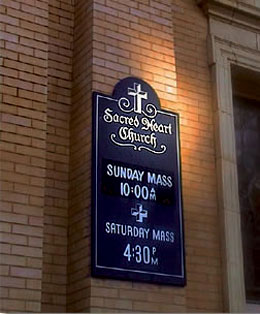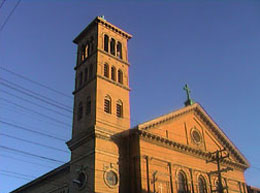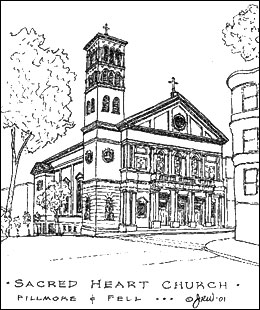
Sacred Heart Parish of San Francisco, at the corner of Fillmore and Fell Streets, is a readily recognizable landmark from many vantage points in the City, overlooking the Western Addition and the Hayes Valley neighborhoods. With its unique Italianate exterior it sits majestically on the hill. As far as research has shown, there is only one other church in California in this style, located in Pasadena and constructed only in 1936. Sacred Heart Parish represents the last ecclesiastical building still standing by architect, Thomas John Welsh.
In his time, Welsh (1845-1918) had become the major architect for the Archdiocese of San Francisco. Some of his greatest achievements were: the original St. Dominics, the original St. Peter & Paul in Northbeach, the Dominican Convent in San Rafael, St. Bridges School, St. Charles School, St. Brendon's Church, and Our Lady of Guadalupe Church. All of his churches were destroyed in the 1906 earthquake, with the exception of his masterpiece, St. Mary's Cathedral (replaced after the fire of 1962), and Sacred Heart Parish.
Sacred Heart Parish was established in 1885. After existing in various structures, the cornerstone for the present church was laid in 1897. The church was completed in 1898. The first part of construction cost $60,000.00. This price did not include the front portion, called the transept. The three Carrara marble altars in this area along cost $15,000.000.
Sacred Heart was particularly helpful after the 1906 Earthquake, providing food and shelter for the City's homeless. The Church sustained little if any damage in the '06 quake. With shifting religious demographics, we fast forward to the Quake of '89. The church came through with only slight patches of fallen plaster from the highly ornamented ceiling decorated with frescoes and Apostles. There are cracks, but no plaster has fallen in the past eleven years--hence why the protective netting is still in place today. The West side of the bell tower also sustained a couple of cracks.
Through the next twelve years, the fate of the Church has volleyed back and forth. Committees have started up and then faded, because they never got anywhere. No real answers have ever come up. No real fundraising strategy has ever been implemented. We, the parishioners, have only gotten secondhand information passed down.
In 1997, a plan by the Marchese Co. was drawn up for alternate uses and retrofitting. To date, the parishioners have never been allowed to see this plan, though many have requested to at least look at what was proposed at that time.
In the last months of 2001, surveys were passed out at Church. The response from these surveys was resounding: people wanted the present Church. But later at a "town hall meeting," it was decreed that there was no way to save the Church, and we'd better go along with the plan for housing and a small token place of worship--or else the Parish would be closed.
We also have not been allowed to institute a viable retrofitting fundraising plan. Our plight has not been brought to the community to see where we could obtain major support to help save this unable-to-be-designated landmark.
On December 14, 2001, it was officially announced that Archbishop William J. Levada has finally decided to allow the parish itself to continue to exist and remain operating. Nothing at that time was stated as to the future of the church.
We need alternate use proposals to bring in sustainable funds to keep the structure a part of the community. Suggestions from anyone with community needs who could benefit from use of any of the facilities are greatly welcomed.