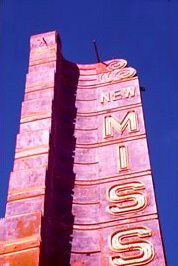

The New Mission Theater News Updates
The New Mission Theater Chronology
San Francisco Press Coverage index of the New Mission and single screen theaters
12-04-03: CCSF Board accepts Gus Murad $4.5M offer to buy New Mission
The Friends of 1800's Letter to the San Francisco Board of Supervisors
Photos of
the New Mission Theater from 2001 and earlier
THEATER-RELATED
On December 4, 2003, CCSF Board rejected the offers of both Cullinane & Long and the Pacific Institute, in favor of Gus Murad & Associates.
CCSF SALE OF NEW MISSION THEATER - UPDATE 12-04-2003
SF Community College District's Board of Trustees met in a contentious four-hour meeting on 12/4/03. Public comment skewered the Board over its rushed timeline, its lack of community outreach and the lack of prior participation of advisory groups. Despite public entreaties to reconsider a definitive vote at this hearing, Board members repeatedly expressed their constraint to act now, rather than risk further setback.
Of the three bids being considered, the nonprofit Pacific Institute's $3.3M offer most clearly articulated the intention to restore the New Mission Theater, as well as develop housing and community programs, building on their their work in care for the frail elderly in Hayes Valley. However, the staff had drafted only two resolutions to be voted upon, presenting a choice only between Cullinane & Long and Gus Murad & Associates.
Although Cullinane & Long, a commercial developer, offered the highest bid of $4.7M, the resolution accepting their offer was voted down as being the least responsive to both preservationist and community programming needs.
Gus Murad & Associates made a $4.5M offer that proposed renovating the theater and using the adjacent Giant Value property as a mixed-use commercial/residential project. While speaking to the Board, Gus Murad expressed doubts that the theater could be fully self-supportive, and contemplated that revenues from the development of the Giant Value portion of the site might have to subsidize the theatre restoration. He also noted that reconfiguring portions of the theater to create more than one screening space while retaining the architectural integrity of the building might make sense.
Tomas Lee, representing Tom Ammiano's office, read a statement from Ammiano which raised the issue of turning the site, the only remaining publicly held property in the vicinity, over to the City as eminent domain. This seemed to be a somewhat late suggestion not considered seriously by the CCSF board. On the other hand, the news that the theater is once again on the schedule at City Hall to be designated a city landmark was definitely heard by all present.
A risk consideration repeatedly brought up by Trustee, Rodel Rodis, was that if the Board were go with the lowest bid, the current tenant, Giant Value, having "right of first refusal" would then be able to buy the building and then re-sell for the profit CCSF could have realized.
Board Member Johnnie Carter had proposed first amending one of the two resolutions in favor of the Pacific Institute. Counsel Gerry Stubbs felt that such an amendment was not possible, and that only a new resolution could be proposed and then voted upon. Stubbs also said, somewhat ambiguously, that the purpose of the meeting was to choose one of the three offers, and that the board could simply vote for or against each of them.
Stubbs was frequently called to the podium to answer questions from the board, including whether or not City College is a state agency. Under state law, state agencies are required to consult with the California Office of Historic Preservation early in the planning processes when contemplating the sale of a historic property. Although Chancellor Day has specifically noted the District's status as a state agency at public hearings regarding the historic designation of the New Mission Theater, Stubbs advised the board that it was in fact a local agency. National Trust lawyer Mike Buhler pointed out this glaring inconsistency and urged the board to initiate consultation with the Office of Historic Preservation before completion of the sale.
In any case, on a voice vote the Board rejected the possibility of a third resolution, thereby declining the Pacific Institute's offer. The Board was then faced with a decision to reject all offers and start over, a setback Rodis emphatically warned could mean another nine months of delays. In the end, Gus Murad's offer was reconsidered and given approval. The Board quickly adjourned without any further comment.
The opportunity to include a covenant or other written protection
for the theater at the time that it changes hands was missed during
the final frenzy of voting and confusion over procedures. The
Chancellor acknowledged that the counsel who should have been
present at the meeting in order to answer procedural questions
was absent for an unknown reason, and many questions remain about
the validity of the voting due to the lack of proper procedures
of order.

In the end, the events clearly demonstrated
that we have made substantial (if less than perfect) progress.
Every board member, save one, made strong public comments in favor
of preservation of the theater. The Administration showed a clear
preference for preservation through its recommendation that the
Murad bid be chosen over the highest offer.
Most importantly, the chosen bid is from an entity that has promised in writing, and in a public forum, to preserve the theater. While none of these developments guarantee a favorable result or are equivalent to a binding pledge for preservation, they do demonstrate a decided shift in the overall mentality of those involved in this debate. Everyone involved in our efforts should be proud of that result.
Unlike in previous meetings on this matter at City College, which
has now identified a new site for its Mission campus, there was
an overwhelming mandate presented by the public in favor of preservation.
We hope that the chosen developer will follow through on his
preservation pledge.

Despite the fact that a developer
who has expressed an inclination to preserve the theater has been
chosen, this battle is far from over, and many potential pitfalls
remain. Clearly, the potential for the existing tenant to
acquire the property and develop it with no regard for the theater
is a concern. Likewise, the fact that the Cullinane & Long proposal
was approved as a back-up bid is also disconcerting.
Nonetheless, we are doing everything we can to ensure the long-term safety of the theater including the effort to acquire local landmark status for the property.We will continue to work with City College and the ultimate buyer of the Theater to work toward a positive preservation solution.