
While there's no shortage of queer folk in the preservation movement, as volunteers and preservation professionals, there are very few positive depictions of GLBT identity at the historic sites and buildings that are our life's work. The stigma of deviance has kept interpreters silent on the subject of sexual orientation even at historic houses where the cat has been out of the bag for a long, long time. Though Walt Whitman and Willa Cather are widely honored as distinguished American writers, those who manage their houses presume to manage their reputations by insuring that visitors learn nothing about their same-sex relationships. The closets are even deeper at historic houses associated with national political leaders, such as Eleanor Roosevelt's Val-Kill, despite recent scholarship that has provided compelling evidence of same-sex intimacies in these settings.
Among liberals, sexual orientation and identity has long been perceived as a private matters. Corollary thinking suggests that we have no business "outing" closeted gay people and that sexual orientation is largely irrelevant to the interpretation of the past or current practices (such as fitness to serve in the military). While the idea of privacy continues to be critical to protecting the right of queer folk to love whomever they choose, it is an increasingly problematic concept for public policy and practice, particularly when it is used as a rationale for the suppression of public discourse on controversial subjects.
While Georgia O'Keeffe, for example, may have preferred that her intimate relationship with Maria Chabot remain a secret, and the architect Philip Johnson lived most of his adult life as a closeted gay man, the fact of their same-sex relationships is critical to understanding how their houses in Abiquiu and New Caanan, respectively, came into being. In the case of O'Keeffe, her on-again, off-again romance with Maria Chabot is critical to understanding the landmark. In the words of Paula Martinac, "the renovation of the Abiquiu house was overseen by Maria Chabot, a writer who began living with O'Keeffe in 1941 in an intimate friendship 'a tall handsome young woman,' as O'Keeffe described her. Maria planned all the details of the renovation, including the location of the fireplaces, and studied Hopi architecture in order to duplicate its designs." The major biographies of O'Keeffe all acknowledge Chabot's leading role in the renovation. In Johnson's case, the remarkable collection of art in his landmark Glass House was collected and curated by David Whitney, Johnson's lover of more than 30 years.
Reluctance on the part of historic site administrators to honestly address aspects of sexual orientation and identity that diverge from societal norms parallels problems in telling the truth about slavery in the Great Houses of the South. For years slaves were inaccurately described as "servants" and the subject of slavery was whitewashed through demolition or neglect of the slave quarters. Docents are often uncomfortable with controversial topics and fear visitors' responses. To address this problem, the National Trust for Historic Preservation has initiated a special educational program intended to improve the interpretation of slavery at the historic houses it owns and manages. Who will make a similar case for addressing difficult subjects in an accurate and complete way at O'Keeffe's studio and Johnson's Glass House, which were recently acquired by the National Trust? The time has come for the GLBT movement to hold preservation organizations and agencies accountable for their treatment of the subject.
Same-sex relationships are often obscured at the landmarks of GLBT heritage through asexual euphemisms such as "special friend" or "associate," if they are dealt with at all. At some places, there is an informal policy to address difficult subjects only upon request. Photographs that might raise questions, such as Willa Cather in masculine attire as her alter ego Frank, have no place on the wall of her childhood home. Taken together, these erasures surely make the stories told at these sites more palatable to the most conservative visitors. Yet they represent lost opportunities for educating the public about GLBT history and they leave queer folk and their allies profoundly uncomfortable as they beg the truth about the past. Perhaps it is time to stop being such good guests and to instead "act up" on our visits to historic houses?
Beyond the homes of notable individuals, there are also sites associated with the GLBT movement that merit landmark designation. Recent scholarship has documented the history of the movement, but the need remains to link that history to historic places. Perhaps the premiere example is the Stonewall Inn on Christopher Street in New York City, which was the site of the June 28, 1969, police raid where patrons (mostly drag queens and people of color) fought back in response to police harassment. This was the first historic property to be listed on the National Register, in 1999, and to be designated as a National Historic Landmark because of its significance in gay and lesbian history.
More recently, Chicago's Commission on Landmarks awarded preliminary landmark status to the former home of the late pioneering gay activist Henry Gerber (1882 - 1972), who in 1924 founded the Society for Human Rights, which is believed to be the first gay and lesbian civil rights organization in the nation. Since the Chicago City Council holds the power to grant final approval of landmark status, lobbying in the year ahead is warranted.
Public debate over most landmark nominations focuses on questions of historical significance, the integrity of the remaining physical resources, economic impacts and development alternatives. Questions of morality, however, tend to come into play when the landmarks of GLBT history are proposed for designation, with queer folks claiming we need role models and homophobes arguing against the government legitimizing deviant lifestyles. Queer history is not the only subject that can elicit this type of response. The home of Al Capone, Margaret Sanger's birth control clinic, anarchist Emma Goldman's apartment, and other properties have been the focus of these sorts of controversy. For that reason, preservationists need to be prepared to make the case for preserving historic places based on their historical significance and level of integrity, without making the mistake of selecting only those places that reflect our values. The election of George W. Bush casts a shadow over recent progress in adding so-called "lavender landmarks" to the National Register of Historic Places. However, more liberal political regimes in some localities may allow for new local landmark designations during the next few years, with the added benefit of having enforcement powers, such as stays of demolition, that do not accompany National Register listing.
Whereas the term queer once was a putdown that meant deviant, it has been reclaimed by GLBT people who now wear the badge of difference proudly and defiantly. The literature on gay and lesbian history is now abundant; however attempts to present that history in public venues, such as in schools and at historic properties, continues to provoke intense resistance and fiery controversy. For that reason, questions of preservation and interpretation merit the attention of progressive planners who are committed to an agenda of inclusion. Yet preservation itself has an uneasy place within planning and only a few programs assert the relevance of preservation to planning education. Even fewer have redefined preservation planning in ways that make it a democratic and inclusive sphere of activity. Progressive planners, however, have a common interest in making sure our landmarks reflect histories and points of view marginalized and suppressed by the dominant culture.
Landmark designation of Emma Goldman's New York City apartment, where she published the Mother Earth News and worked at defining the meaning of "free love" in practice, would provide a touchstone for the anarchists who fomented unrest at the recent WTO meeting in Seattle. Such a landmark implicitly would acknowledge anarchism as an important and enduring strand of American political thought. In the past, however, the National Park Service has declined to pursue National Historic Landmark status for Goldman's apartment, citing a policy against designating places (such as apartment houses) where the significance lies in only one part of the building. Yet the association with anarchism also appears to have scuttled the landmark.
Without marking Margaret Sanger's birth control clinic, the issue of women's right to control our bodies seems like a recent problem, rather than an enduring struggle. During the last Bush administration, the nomination for this property was long-delayed on account of vague fears that designation of the clinic somehow would imply Executive and Congressional approval of abortion rights, though it finally won National Historic Landmark designation. GLBT rights would seem more fragile for lack of marking the progress we've made during the past 30 years at the Stonewall Inn. Reaching back yet another 50 years to 1924, through the designation of Henry Gerber's house, would connect the GLBT movement to a longer tradition of struggle against oppressive social and sexual norms. Likewise, the long struggle for racial equality and social justice is affirmed by the designation of the Underground Railroad and the landmarks of the Civil Rights Movement. Having a sense of heritage clearly nurtures contemporary political action.
Planning education hasn't exactly embraced cultural matters within its comprehensive vision. Yet the Culture Wars contribute to the erosion of freedom in the public realm as surely as malls, privatization, and the other nemeses of progressive planning. The task that lies ahead for progressive planners of all sorts is to forge alliances that insure we support one another across lines of difference in making claims to a heritage that resonates. By saving these places and insisting that we use them to tell the truth about the past, we make space for a future in which everyone is welcome.

(1) Martin Filler, "The Architect of a Master Builder's Store of Art," New York Times (2 June 1996), Section 2, 37 and 40.
(2) Paula Martinac, The Queerest Places: A National Guide to Gay and Lesbian Historic Sites (New York: Henry Holt, 1997),120.
For a report of the path-breaking landmark designation of Stonewall Inn, see David W. Dunlap, "Stonewall, Gay Bar That Made History, Is Made a Landmark," New York Times (June 26, 1999), Late Edition (East Coast), 1. Christopher Thomson also provided an insider's account of the NRHP and NHL designation process in an oral presentation at the Third National Conference on Women and Historic Preservation in Washington, DC (May 20, 2000).
Copyright, 2002. Thanks to Planners Network for allowing us make this article available.
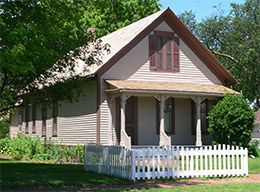
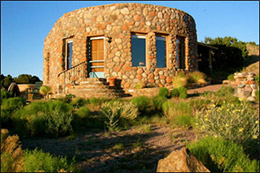
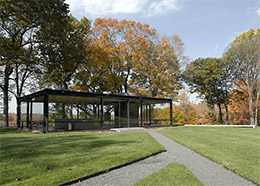
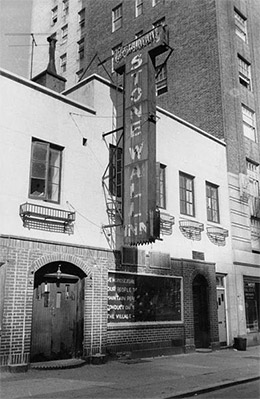
Top to bottom: Will Cather House; Abiquiu; Philip Johnson's Glass House; the Stonewall Inn.
Gail Dubrow is Associate Professor of Architecture, Urban Design and Planning at the University of Washington, where she also serves as Associate Dean and Director of the Preservation Planning and Design Program.
This article condenses some of the arguments contained in her longer essay, "Blazing Trails with Pink Triangles and Rainbow Flags: New Directions in the Preservation and Interpretation of Gay and Lesbian Heritage," originally published in Historic Preservation Forum 12:3 (Spring 1998): 31-44.
References to Trust-owned properties that were censored in the Forum article appear in Gail Dubrow and Jennifer Goodman, eds., Restoring Women's History Through Historic Preservation (Baltimore: Johns Hopkins University Press, forthcoming).
