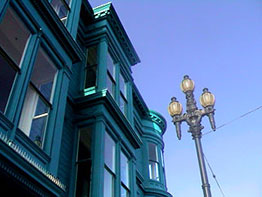
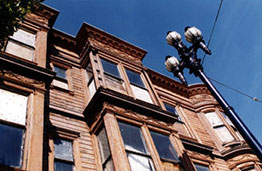
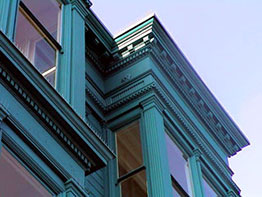
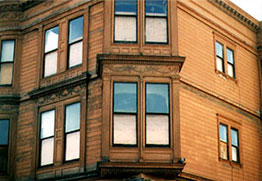
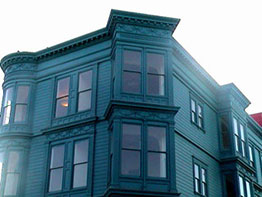
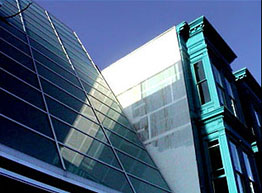
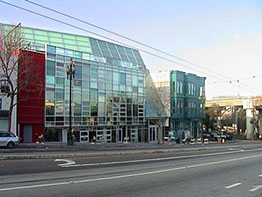
This is a story about the Carmel Fallon Building that underscores the reality that even some twenty years after Robert Venturi's "Complexity & Contradiction in Architecture" and some thirty years after the first high profile preservation battles such as the effort to save Pennsylvania Station, the practice of using applied ornament in architecture still seems illicit, immoral and unnecessary to many people.
On March 7, the Community Center Project voluntarily presented an update on the status of the restoration work on the Fallon building to the Landmarks Preservation Advisory Board (LPAB). Towards the end of that presentation, the architect Jane Cee mentioned that the plaster ornament on the friezes around the building would not be restored or replaced. The frieze at the top of the second and third floors had been originally been made up of a series of plaster garlands of leaves and ribbons. These had been largely in place when the Community Center Project (CCP) took possession of the building, but many had fallen off in the periods before and after construction started.
Ms. Cee maintained that Nibbi Brothers (the contractor) had quoted the CCP a price in the tens of thousands of dollars to replace the ornament and that this was beyond their budget. She also was of the opinion that the ornament was not important and that no one would notice its absence. The Landmarks board position was that they "encouraged the project sponsors that if there are any savings in the budget or additional fund raisings, that [it be used so that] the replacement of the appliqué (garland) will not be allowed to fall out, and be given some priority attention and be saved, if possible. The Board feels that the appliqué (garland) is an important part of the aesthetic of the building." (from the minutes of the LPAB, March 7, 2001)
The Friends voiced their support for the restoration of the plasterwork at the hearing and subsequently contacted various plaster specialists to get other opinions on the cost of replacement. By chance we contacted one of the people who had bid on the job who said it could definitely be done for less than $8000. The Friends lobbied the LPAB over several months to encourage them to act, arguing that the ornament was an essential part of the exterior architecture of the building:
"We feel that the plasterwork ornament (the continuous row of ribbon garlands) is an extremely important part of the look of the building. This style of architecture is to a great extent a system of ornament. This building, although Victorian, uses an Italian Renaissance Classical system of ornament. Small fluted pilasters frame the windows and a horizontal beam (the entablature) appears to be supported by them. An ornamental band (the frieze) is the enriched part of the entablature.
"When friezes, or other larger members, are to be enriched, the ornaments may be significant, and serve to indicate the destination, or use of the building; the rank, qualities, profession, and achievements of the owner"
—American Builder's Companion, 1806, page 29.
Carmel Fallon, by having an enriched frieze was communicating to the world her wealth and position. To remove the frieze changes the essential nature of the exterior, changing it into a plainer, less important building. It is as if you took a painting and decided that you didn't really need all the reds because they were too bright, or decided to cut the loud notes in a piece of music because they were too imposing. You completely have changed the nature of the work.
Following the Friends letter to the LPAB of 3/18/01, the LAPB eventually agreed that the ornament was essential and informed the CCP in a letter on August 8, 2001 that it was obligated to restore the ornament at least to the state it was in when the building became their property in 1998.
The CCP agreed to restore the ornament, and has now stated that the work will cost $6000. Gary Nathan on behalf of The Spectrum has already donated $1000, and the Friends are going to donate $1000. As you have probably read in the paper, the CCP is still behind in their fundraising and needs help specifically on raising funds to restore this ornament. All donations would be greatly appreciated and should be made out to the Community Center Project.
It is clear from the comments of Ms. Cee and letters subsequently written to the editor about this matter that even now in 2001 applied ornament is still belittled (wittingly or not) by those under the influence of the dubious puritanical prejudices of the International Style. I have never been able to understand how a carving or a bit of paneling can be moral or immoral. To me people are moral or immoral, not things. If we talk about expenditure of resources, then you can have a discussion about morality (but this is not a discussion about aesthetics). One argument used against ornament by the Modernists was that it was a waste of money. This was hypocritical in the face of the fact that the first Modern buildings and the high art Modern buildings now being built are typically extremely expensive. In the case of the Community Center Project, they could only justify the wasted expense of the useless slanted wall by saying that otherwise the building would be too boring. Modernists feel the absence of ornament so strongly they tend to turn the whole building into an expensive bauble.
To leave you lovers of ornamental and symbolically complex architecture with something to ponder I leave you with a comment of Theodor Adorno regarding Adolf Loos, one of the founders of Modern architecture:
Loos traces ornament back to erotic symbols. In turn, his rigid rejection of ornamentation is coupled with his disgust with erotic symbolism. He finds uncurbed nature both regressive and embarrassing. The tone of his condemnations of ornament echoes and often openly expressed rage against moral delinquency: "But the man of our time who, out of inner compulsion, smears walls with erotic symbols is a criminal and degenerate.
—T. Adorno, Functionalism Today, ©2002.